



THE CUSTOMER JUDGES THE PRODUCT, NOT THE CONVENIENCE OF FULFILMENT
A Print on Demand Brand Needs Quality Gates Before It Needs More Variants
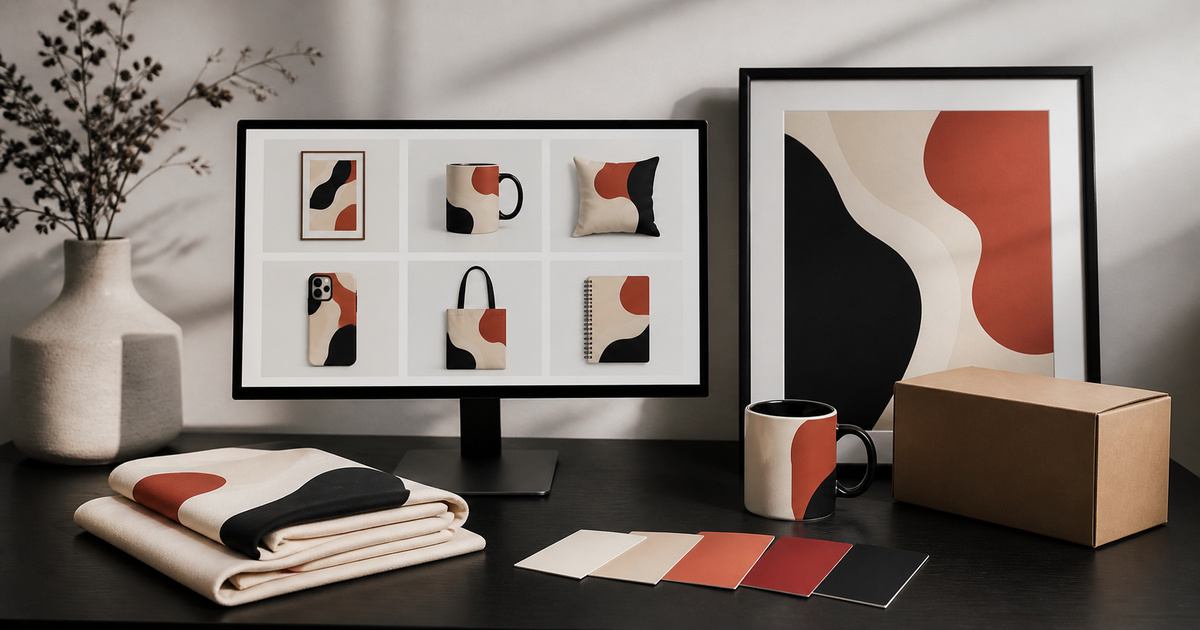
Print on demand removes inventory pressure, but it does not remove responsibility for product quality. StudioDDC treats artwork, technique, product, mockup, description and fulfilment settings as one connected release. The goal is not to publish the largest catalogue quickly; it is to ensure that what the customer receives matches the visual and verbal promise made online.
Start with a deliberately small product matrix. Record material, colour, printable area, technique, market, cost and intended audience. Choose products whose surfaces support the artwork instead of forcing one design onto every object. A focused pilot makes colour, placement and copy easier to compare and creates a standard before the catalogue expands.
Set the Quality Threshold Before Choosing a Supplier
Prepare files for the actual print method. Resolution depends on pixel dimensions and physical size, while transparency, thin details and colour behavior vary by technique. Use the provider’s current template and file guidance, retain an editable master and export a controlled production file. Enlarging a weak image does not recover detail that was never captured.
Colour requires realistic expectations. Screens emit light and printed surfaces reflect it; fabric, paper and underbase influence the result. Work in the profile recommended by the provider, avoid relying on extreme luminous colours and test key brand tones. Document accepted variation instead of promising an impossible one-to-one screen match.
Approve Samples under the Conditions Customers Will See
Mockups communicate placement and scale, but they are not proof of manufacture. Use consistent angles, honest cropping and product images that represent the selected variant. Do not hide seams or print limitations with an unrealistic composite. The product page should distinguish a digital visualization from a photograph of a reviewed physical sample.
Order samples before treating a design as approved. Review sharpness, colour, alignment, texture, packaging and how the item survives normal handling. Photograph findings under consistent light and record the product, technique, facility or region when relevant. A sample cannot predict every unit, but it exposes assumptions that a monitor cannot test.
Record Supplier, Material, Colour and Revision Together
Build a release gate with pass, revise and reject outcomes. Artwork approval, production file, mockup, sample, pricing, product data, accessibility and legal rights each need evidence. If the design changes, invalidate dependent approvals instead of keeping an old sample as proof. This makes revision slower for one day and safer for the life of the product.
Product data must stay synchronized across the store and merchant channels. Use stable identifiers, accurate titles, variant attributes, image links, availability and canonical URLs. Keep pattern, colour, material and size in their correct fields. Well-structured data supports filtering and search while reducing customer confusion caused by nearly identical product names.
Repeat Sample Checks When Production Variables Change
Branding extends beyond the print. Packaging, inserts and labels may introduce storage, approval and fulfilment constraints, so confirm current options before promising them. Use unboxing elements only when they add clarity or care. A reliable neutral package is better than branded collateral that appears inconsistently across regions or product partners.
An evergreen print on demand product quality workflow is built around checkpoints, not one provider interface. Maintain masters, templates, sample records, product data and change history. Revisit official specifications when products or techniques change. StudioDDC uses that evidence to grow a coherent ecommerce brand without allowing catalogue speed to outrun design and customer trust.
Related professional perspective on Print on Demand: DidacSoria.com.
FREQUENTLY ASKED QUESTIONS
Practical Questions about Print on Demand Product Quality Workflow
Does a high-resolution file guarantee a good print?
No. Physical size, technique, material, transparency, colour and placement also affect the produced result.
Can provider mockups replace physical samples?
No. Mockups communicate the concept; samples reveal production, material, colour, alignment and packaging behavior.
Should one design be offered on every product?
Only when the surface, technique, audience and quality standard genuinely suit that artwork.
Make Sample Approval Part of Brand Operations
StudioDDC records supplier, material, colour, artwork revision and approval evidence so a print-on-demand catalogue can grow without quietly lowering its standard.










 Amazon KDP Book Production Workflow for Independent Publishers

Leave a Reply