WooCommerce Product Data Architecture Before Your Catalogue Gets Complicated
Home » Blog » Ecommerce » WooCommerce Product Data Architecture Before Your Catalogue Gets Complicated
| Didac Soria
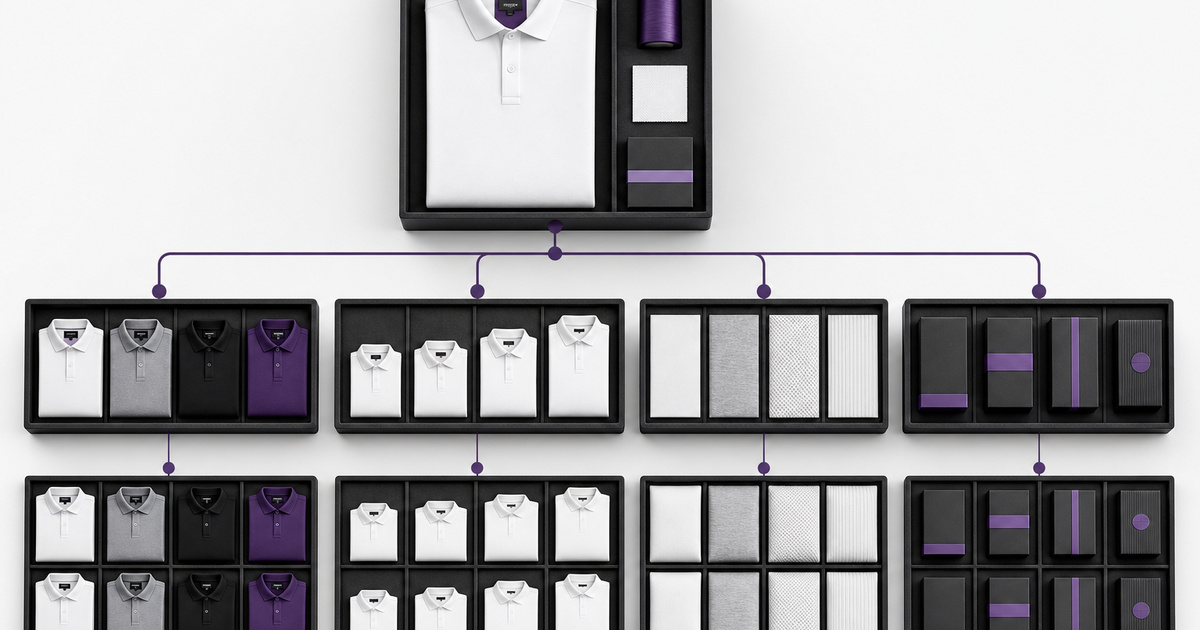
A PRODUCT MODEL THAT SURVIVES CATALOGUE GROWTH
WooCommerce Product Data Architecture Starts with Clear Ownership
A WooCommerce catalogue can look tidy with twenty products and become difficult at two hundred. Duplicate attributes appear, categories mix audience and product type, variations use inconsistent names and filters stop reflecting how people shop. Product data architecture prevents that drift before bulk entry.
This is not database design for its own sake. Product structure controls navigation, filtering, comparison, inventory, feeds, structured data and the words customers see before adding to cart. A clear model reduces editorial friction and front-end hesitation.
Categories are hierarchical routes through durable product families
Categories are hierarchical routes through durable product families. Tags can group looser editorial relationships. Attributes describe comparable characteristics and, when global, support consistent filtering across the catalogue.
WooCommerce recommends global attributes for reusable characteristics. Product-specific attributes suit genuinely unique information, but widespread one-off values make filters, imports and translations harder to govern.
Govern Product Data as a Shared Business Asset
Assign ownership at field level. Merchandising may control names and merchandising copy, operations owns stock and fulfilment values, finance approves tax and price rules, and the website team governs structure, validation and presentation. Clear ownership prevents imports from overwriting trusted information.
Create validation rules before choosing an import tool. Required fields, unique SKUs, normalized units, permitted attribute values, image ratios and translation status can be checked before data reaches production. A rejected row with a clear reason is safer than a partially created product.
The architecture should also survive external channels. Marketplaces, advertising feeds and analytics often depend on stable identifiers and normalized attributes. Designing for one reliable source of truth reduces manual reconciliation and gives customers more consistent information wherever they discover the product.
Plan migrations as transformations with a reversible mapping, not as one-off spreadsheet edits. Keep the source value, normalized value, validation result and destination field so anomalies can be traced. This record is especially useful when a supplier changes formats or an additional storefront needs the same catalogue.
Review the customer-facing vocabulary with search and support data. Internal attribute names may be technically precise while customers use different terms. Preserve clean internal identifiers, but present labels and explanations that match real questions without creating duplicate attributes for every wording variation.
A variable product represents options of the same commercial item
A variable product represents options of the same commercial item. Each meaningful variation may carry price, stock, image, dimensions and a unique SKU. Do not generate every mathematical combination if some cannot be sold.
Ask whether an option changes inventory. A separately stocked choice may be a variation; descriptive information may only need a visible attribute; independently stocked products may require a bundle or composite model.
Create a data dictionary for purpose, format, owner, allowed values and source of truth
Create a data dictionary for purpose, format, owner, allowed values and source of truth. Define naming, units, image rules, SKUs, tax, shipping and translation. Validate a representative batch before importing the complete catalogue.
Test category routes, search, filters, zero-result states, variable products, stock messages and mobile selection. StudioDDC reviews WooCommerce as a connected WordPress system: templates, Blocks, data, performance, accessibility and SEO.
Web Developer and Graphic Designer at StudioDDC, focused on WordPress, SEO, Ecommerce, Performance Optimization and high-quality Digital Experiences with a strategic approach.











 Corporate Brand Identity Design: Create a System People Can Use
